
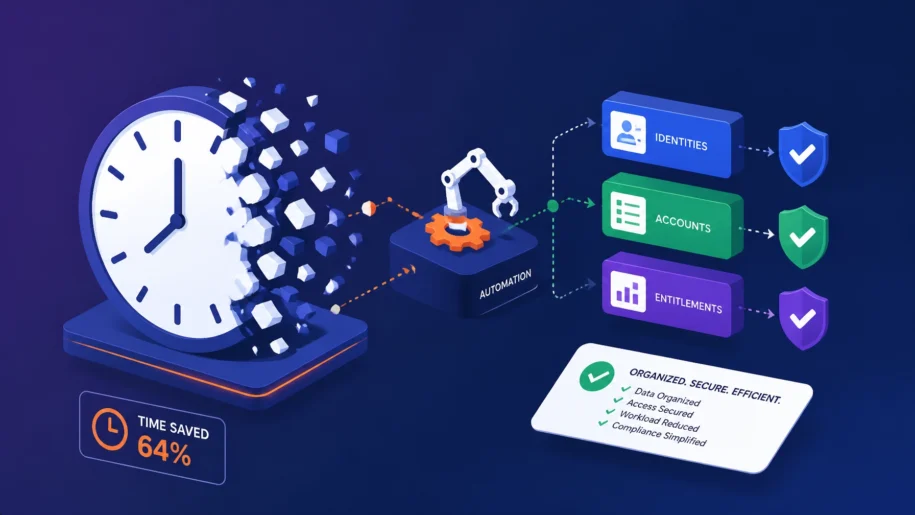
Let’s be real for a second: most security teams are drowning in spreadsheets. If you’re a PAM lead or an IAM governance pro, you know the "Audit Season" dread. You spend weeks chasing down server admins, export-pasting Active Directory groups into Excel, and trying to figure out why a random service account from 2018 still has Domain Admin rights.
It’s a massive time-sink. It’s manual, it’s error-prone, and frankly, it’s a waste of your team's specialized talent.
We’ve seen it time and again. Enterprises invest millions into enterprise PAM solutions (the vaults, the session managers, the rotators), yet the governance team is still doing manual "walkthroughs" to satisfy auditors. Why? Because while the vault secures what you know about, it doesn’t tell you about the "Shadow Privilege" lurking in the corners of your hybrid cloud.
At OrbisID, we believe that your time is better spent solving complex security problems, not playing detective with a CSV file. That’s why we’ve developed a proven framework for an automated privileged access audit. This isn’t just about security; it’s about operational sanity.
Intro: The Manual Tax on Security Operations
The "Manual Tax" is the hidden cost of traditional IAM governance. Every hour spent manually reconciling accounts is an hour not spent on threat hunting or architectural improvements. In a complex, multi-domain environment, the volume of privileged accounts grows faster than any human team can track.
When we talk about automation efficiency, we aren’t just talking about clicking a button. We’re talking about a systemic shift in how you handle discovery, classification, and reporting.
The Problem: The Managed vs. Unmanaged Gap
Most enterprise PAM solutions are excellent at managing the accounts you put into them. But they have a blind spot: they can't manage what they haven't discovered. This results in a "Security Illusion": you think you’re 100% covered because your vault is full, but your actual Active Directory or Azure AD environment is littered with "Shadow Privilege."
Shadow privilege refers to accounts with elevated entitlements that exist outside of your standard PAM program. These are the primary targets for attackers and the #1 reason for SOx or ISO 27001 audit findings.
Step 1: Automated Discovery (Killing the Spreadsheet)

The first step in reclaiming your time is moving from manual snapshots to continuous, automated discovery. If you are still asking for AD exports once a quarter, you are already behind.
Technical Specs: Complete Discovery
We provide an automated engine that eliminates the need for manual scanning. The discovery process includes:
- Active Directory Scanning: Automated enumeration of AD groups, privileged accounts, and service accounts across all domains and OUs.
- Azure AD & Entra ID Discovery: Utilizing Microsoft Graph API to surface privileged roles, guest accounts, and service principals across cloud identity estates.
- Windows & Linux Coverage: Scanning for local administrators, sudoers, and privileged service accounts across your server estate.
By automating this phase, you remove the "Shadow Privilege" blind spot. You no longer have to wonder if a new admin account was created without your knowledge: the system finds it for you. This is the foundation of a modern automated privileged access audit.
Step 2: Intelligent Classification (Humans vs. Machines)
Discovery is only half the battle. If your scanner returns 5,000 accounts, you’ve just traded a discovery problem for a classification problem. This is where teams lose weeks of time: manually figuring out if SVC_SQL_01 is a human-owned account or a legacy service account.
Specs: Human & Non-Human Categorization
We intelligently categorize every privileged account to provide clarity for governance teams:
- Human Identities: Identifying accounts tied to real employees or contractors.
- Non-Human Identities (NHI): Automatically tagging service accounts, managed identities, and API credentials.
- Ownership Assignment: Linking accounts to specific owners or departments to streamline the review process.
Instead of your team guessing who owns what, the platform provides a categorized inventory. This allows you to prioritize high-risk human accounts for immediate vaulting while handling service account rotations on a different track.
Step 3: The PAM Gap Analysis (Reconciling the Vault)

This is the "Aha!" moment for most of our customers. Once you have a full discovery of your environment, you need to compare it against what is actually inside your enterprise PAM solutions.
We call this the PAM Gap Analysis.
How it Works
The OrbisID platform takes the list of discovered privileged accounts and cross-references them with your managed scope (e.g., your CyberArk or Delinea vault). The results are often eye-opening. You will typically find:
- Unmanaged Admins: Accounts that have administrative rights but are not being rotated or managed by your PAM tool.
- Orphaned Accounts: Privileged accounts that no longer have a valid owner in HR systems.
- Policy Breaches: Accounts that bypass your governance rules (e.g., direct membership in the "Domain Admins" group instead of through a managed group).
By automating this reconciliation, you can produce a "To-Do" list for your PAM engineers in seconds, rather than weeks of manual data-massaging. You can read more about why this is critical in our post on The Clean AD Myth.
Step 4: Compliance-Ready Reporting (Winning Your Weekend Back)

The final piece of the framework is reporting. Traditionally, preparing for a SOx or GxP audit involves pulling logs, taking screenshots of "proof of control," and writing long-winded explanations.
We’ve automated this into Compliance-Ready Reporting.
Specs: Automated KRIs
The system generates PAM Governance Key Risk Indicators (KRIs) mapped directly to global frameworks:
- Framework Mapping: NIST SP 800-53, ISO 27001, ISO 29146, SOx, and GxP.
- Automated Dashboards: Real-time visibility into your privileged access risk.
- On-Demand Evidence: Generate a PDF or CSV export for auditors that shows exactly which accounts are managed, which are unmanaged, and what remediation steps are in progress.

When the auditor asks, "How do you know you've found all the privileged accounts in your 50-domain forest?" you don't have to stutter. You point to the OrbisID dashboard and show them the automated scan results.
The Results: Automation Efficiency in Action
When you implement this framework, the results are measurable and immediate.
- Audit Preparation Time: Reduced from weeks to minutes.
- Risk Reduction: Elimination of "Shadow Privilege" that traditional tools miss.
- Team Morale: Your highly-paid security experts are actually doing security, not data entry.
- Compliance Posture: A continuous, defensible record of governance rather than a once-a-year "best guess."
For organizations dealing with the complexities of AI agents and modern identities, this automated approach is even more critical. Check out our deep dive on AI Agent Security Risks to see how automation handles these new challenges.
Conclusion: Automate or Stagnate
The "manual way" of doing things doesn't scale. In the modern enterprise, the only way to stay ahead of both auditors and attackers is to automate the mundane so you can focus on the meaningful.
By integrating an automated privileged access audit layer on top of your existing enterprise PAM solutions, you close the governance gap, reclaim your team's time, and finally put privileged access "under control."
Ready to see it in action?
- Try it for free: Download our Community Edition to scan up to 2 target systems today.
- Learn more: Explore our Technical Documentation to see how we integrate with your stack.
- Get started: Visit OrbisID.com to request a demo of our Pro and Enterprise features.
{“@type”:”BlogPosting”,”image”:”https://cdn.marblism.com/Nb0Nv0GBCK6.webp”,”author”:{“name”:”OrbisID”,”@type”:”Organization”},”@context”:”https://schema.org”,”headline”:”The Proven Framework to Reclaim Your Team’s Time with Enterprise PAM Solutions”,”keywords”:”automated privileged access audit, enterprise PAM solutions, PAM governance, shadow privilege, IAM automation”,”publisher”:{“logo”:{“url”:”https://orbisid.com/logo.png”,”@type”:”ImageObject”},”name”:”OrbisID”,”@type”:”Organization”},”description”:”Learn how to automate privileged access audits and eliminate manual spreadsheets using the OrbisID framework. Reclaim your security team’s time and close the PAM gap.”,”datePublished”:”2026-05-28″,”mainEntityOfPage”:{“@id”:”https://orbisid.com/the-proven-framework-to-reclaim-your-teams-time-with-enterprise-pam-solutions”,”@type”:”WebPage”}}