
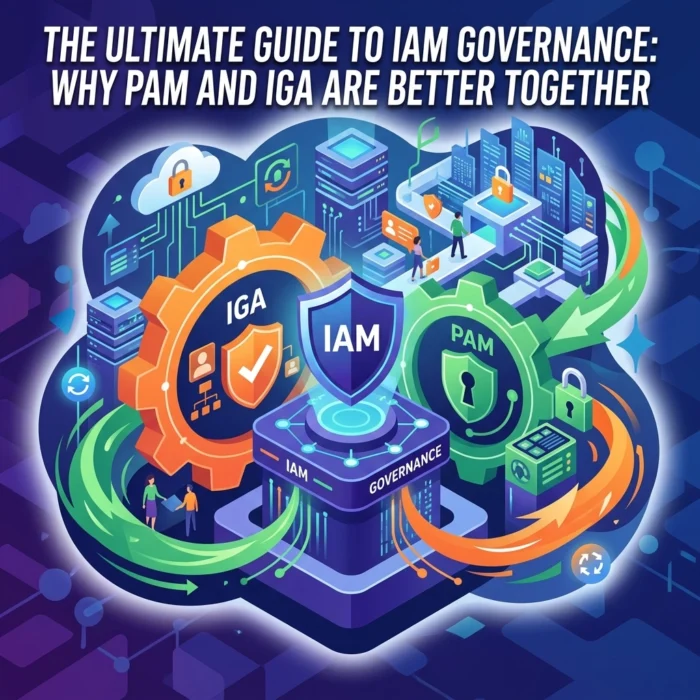
In the current cybersecurity landscape, we often see organizations treating Identity Governance and Administration (IGA) and Privileged Access Management (PAM) as two separate islands. One team handles the "who has access to what" for standard employees, while another team guards the "keys to the kingdom" for administrators and service accounts.
But here is the reality: security doesn't happen in a vacuum. When these two systems don't talk to each other, you create a massive blind spot: one that attackers are more than happy to exploit. We call this the governance gap, and it is the primary reason why IAM governance is becoming the top priority for CISOs in 2026.
At OrbisID, we’ve seen how integrating these two powerhouses can transform a shaky security posture into a fortress. In this guide, we’re going to dive into why PAM and IGA are better together, how to bridge the gap, and why automation is your only path to long-term success.
Defining the Duo: IGA vs. PAM
Before we get into the "why," let’s quickly refresh the "what." While they both fall under the Identity and Access Management (IAM) umbrella, they serve different masters.
Identity Governance and Administration (IGA)
IGA is your foundation. It’s the librarian of your organization. It manages the lifecycle of a digital identity from the moment a person is hired to the moment they leave. It handles provisioning, de-provisioning, and access certifications. Its primary goal is to ensure that the right people have the right access to the right resources for the right reasons.
Privileged Access Management (PAM)
PAM is your vault guard. It focuses specifically on the high-risk, high-value accounts: the ones that can change system configurations, delete databases, or access sensitive customer data. PAM tools provide credential vaulting, session recording, and "just-in-time" access to ensure that privilege access is strictly controlled and monitored.
The Conflict of Interest
The problem is that IGA often stops at the "doorway" of the application, while PAM lives deep inside the infrastructure. Without integration, your IGA system might know that "John Doe" is a Senior Admin, but it has no idea if John is actually using his privileged vault or if he’s bypassed security protocols entirely.

Part 1: The High Cost of Segregated Systems
Why should you care if your PAM and IGA tools are working in silos? Because silos lead to "Shadow Privilege." This occurs when users have elevated rights that your governance team doesn't know about.
1. The Orphaned Account Nightmare
When an administrator leaves the company, your IGA system might disable their standard email and Slack accounts. But if that admin had a local "root" account on a Linux server that wasn't synced with your IGA tool, that account stays active. It becomes an orphaned account: a perfect entry point for a hacker.
2. Manual Audit Fatigue
If you are still using spreadsheets to track who has administrative rights, you are fighting a losing battle. We’ve discussed this extensively in our documentation, where we highlight how manual processes lead to human error. During an audit, your team has to manually correlate logs from the PAM tool with the identity records in the IGA tool. It takes weeks, and it’s usually out of date by the time it’s finished.
3. Compliance Failures
Frameworks like NIST, ISO 27001, and SOX require strict evidence of access reviews. If you can't prove that you’ve reviewed your privileged accounts with the same rigor as your standard accounts, you're going to fail your audit.

Part 2: Why They Are Better Together
When you unify your IAM governance, you create a single source of truth. Here is how the synergy works to protect your perimeter.
Unified Identity Lifecycle
Imagine a world where "Joiner, Mover, Leaver" workflows apply to privileged accounts automatically. When a user moves from a Junior Developer role to a Lead Architect, the IGA system triggers a request to the PAM system to grant them access to the production vault. When they leave, both systems are wiped clean instantly. No manual tickets, no delays, and no leftover access.
Enhanced Visibility and Risk Scoring
Integration allows you to see the "Full Picture." You can correlate behavioral data. For example, if your IGA system sees a user logging in from a new location and your PAM system simultaneously sees a massive credential checkout, you can trigger an automated lockout. This is the power of combined intelligence.
Streamlined Access Requests
Users shouldn't have to go to three different portals to get their work done. A unified approach allows a user to request privilege access through the same self-service portal they use to request access to Microsoft Teams. The governance layer handles the approvals, and the PAM layer handles the technical execution.
Part 3: Solving the "Shadow Privilege" Problem
Shadow privilege is the silent killer of cybersecurity. It refers to accounts that have administrative capabilities but aren't managed by your PAM tool.
At OrbisID, we specialize in identifying these gaps. We provide tools that scan your environment to find every single privileged account and cross-reference them with your PAM vault.

As you can see in the dashboard above, seeing the "Accounts not in PAM" is critical. If your IGA system thinks you only have 50 admins, but our scan finds 150 accounts with sudo rights, you have 100 "Shadow" identities that could sink your company.
Integrating IGA and PAM means these accounts are automatically pulled into the governance loop. If an account isn't in the PAM tool, it shouldn't exist. Period.
Part 4: Achieving Compliance Through Automation
Compliance shouldn't be an annual "scramble." It should be a continuous state of being. By combining PAM and IGA, you enable automated compliance reporting.
Mapping to Frameworks
Modern organizations need to map their controls to specific standards. Whether it's NIST 800-53 or GDPR, you need to prove "Least Privilege."
- IGA proves that the policy exists (e.g., "Only DBAs can access the database").
- PAM proves that the policy is enforced (e.g., "Here is the recorded session of the DBA accessing the database").
When these are linked, your audit report is generated with one click. You can see your maturity level in real-time, rather than guessing based on last year's data.

Part 5: The OrbisID Approach to Unified Governance
We believe that the biggest hurdle to unified IAM governance is the initial discovery phase. You can't govern what you can't see. Most PAM tools are great at managing accounts you know about, but they are terrible at finding the ones you don't.
That is why we recommend starting with a comprehensive PAM Gap Analysis.
- Discover: Scan your entire infrastructure (On-prem, Cloud, Hybrid) for every privileged identity.
- Reconcile: Compare those identities against your IGA records and your PAM vault.
- Remediate: Automate the process of bringing unmanaged accounts under control.
- Govern: Establish a continuous feedback loop between IGA and PAM.
By following this workflow, we help organizations move from a reactive security posture to a proactive one. You can learn more about our specific methodology on our homepage.
Part 6: Practical Implementation Steps
Ready to bring your teams together? Here is a roadmap to get you started:
- Audit Your Current Landscape: Use a tool to identify every privileged account across your network. Don't rely on your current PAM's "Managed" list: it only shows half the story.
- Define Unified Policies: Sit your IGA and PAM teams in the same room. Define what "Privileged Access" looks like for your organization and document it in your internal docs.
- Integrate Workflows: If your IGA tool supports it, use APIs to connect it to your PAM vault. Ensure that every "Leaver" event in your HR system automatically triggers a vault revocation.
- Automate Certifications: Set up quarterly access reviews where managers must justify why their team members still need vault access.
- Monitor for Gaps: Security is not a "one and done" project. Use continuous scanning to ensure that new "Shadow Privilege" accounts don't creep back into your environment.
Conclusion: The Path Forward
The "Ultimate Guide" to IAM governance really boils down to one thing: Visibility.
If your IGA and PAM systems aren't talking, you are essentially trying to guard a house with two different security companies: one that watches the front door and one that watches the safe, but neither knows if the other is actually on duty.
By unifying these functions, you reduce your attack surface, eliminate manual spreadsheet work, and make life significantly harder for cybercriminals.
Are you ready to see where your organization stands? We recommend starting with our PAM Gap Analysis tool. It’s the fastest way to find those hidden risks before someone else does.
Download our guide on identifying Shadow Privilege here.
Stay secure, and remember: Identity is the new perimeter. Let's make sure yours is airtight.