
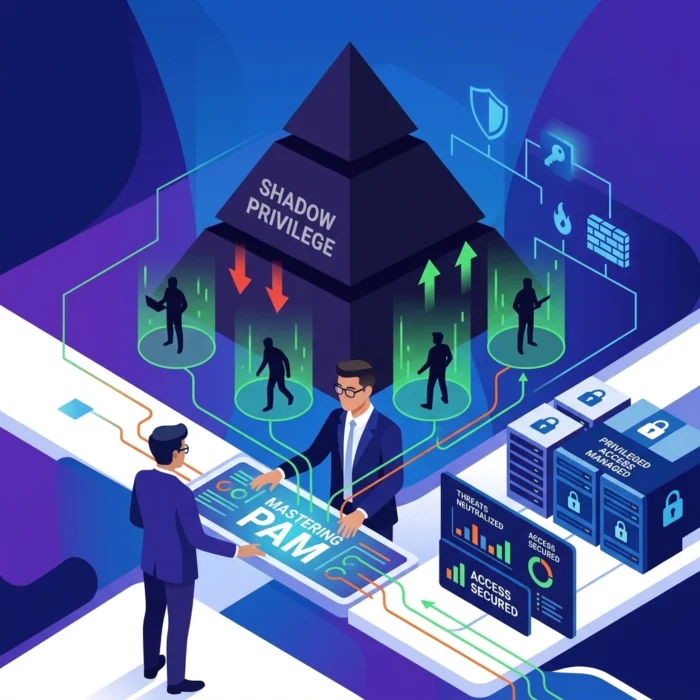
You likely believe you have a firm handle on who holds the keys to your kingdom. You have a Privileged Access Management (PAM) tool, your Active Directory is organized (mostly), and your team follows a strict onboarding process. But here is the reality: there are "ghost" administrators lurking in your environment. These are accounts that don't sit in your "Domain Admins" group but possess the exact same power.
We call this shadow privilege.
In the world of modern cybersecurity, shadow privilege security has become the new frontline. If you are an IT leader, mastering this concept isn't just about better hygiene; it is about preventing the lateral movement that turns a minor breach into a headline-grabbing disaster.
What Exactly is Shadow Privilege?
To understand shadow privilege, we must first look at "Shadow Admins." These are identities: both human and non-human: that have been granted specific permissions which, when combined or exploited, allow them to escalate their rights to administrative levels. The kicker? They aren't explicitly designated as administrators.
Think of it like a back door that someone forgot to lock. Your PAM tool is busy watching the front gate (your known admin accounts), while the shadow admin is walking through the kitchen. This happens through "privilege creep": where a user gains permissions for a temporary project that are never revoked: or through complex nested group memberships in Active Directory.
The Technical Reality of Escalation
From a clinical perspective, shadow privilege security involves identifying "abusable" permissions. For example, a user might have the right to reset passwords for a specific group. If that group contains an administrator, that user is, for all intents and purposes, an administrator themselves. They can reset the admin's password and take over the account.
We see this frequently in multi-cloud environments. You can learn more about securing these complex perimeters in our ultimate guide to multi-cloud PAM.
Why Your Current PAM Tool is Leaving You Exposed
Most legacy PAM solutions are "vault-centric." They are great at storing passwords for known accounts, but they are notoriously bad at finding the accounts they don't already know about. If you haven't told your PAM tool that an account exists, it won't manage it.
This creates a massive visibility gap. We've written extensively about what your current PAM tools aren't telling you. If your strategy relies solely on a vault, you are missing the undocumented access that attackers target first.

The Risk: Lateral Movement and Compliance Failures
Shadow privilege isn't just a technical quirk; it is a major liability. When an attacker gains a foothold in a network, they don't immediately look for the "Root" password. They look for the path of least resistance. Shadow accounts provide that path.
1. Lateral Movement
Attackers use shadow privileges to move from a low-level workstation to a high-value server. By exploiting undocumented rights, they can jump between systems without triggering the alarms associated with "official" admin accounts.
2. Compliance and Audit Risks
If you are aiming for NIST, SOC 2, or ISO 27001 compliance, shadow privileges are an "automatic fail" waiting to happen. Auditors expect you to know exactly who has access to sensitive data. If you have accounts with administrative-level power that aren't in your audit logs, you are out of compliance.
We recommend checking out our guide on how to automate your NIST compliance privileged access reporting to see how modern tools handle this.

3 Steps to Mastering Shadow Privilege Security
We believe that mastering Privileged Access Management requires a shift in mindset. You need to move from "managing accounts" to "managing permissions." Here is how we suggest you start:
Step 1: Continuous Discovery
You cannot secure what you cannot see. The first priority is to run a deep scan of your environment to find every account with elevated rights. This includes:
- Human Accounts: Employees, contractors, and third-party vendors.
- Non-Human Accounts: Service accounts, API keys, and automated scripts.
- Orphaned Accounts: Accounts belonging to former employees that were never fully de-provisioned.
Managing non-human accounts at scale is particularly tricky. We've put together an admin's guide to non-human account management to help with this specific challenge.
Step 2: Implement Least Privilege and JIT Access
Once you’ve found the shadow accounts, you need to strip away unnecessary rights. This is the "Principle of Least Privilege." However, we know that people still need to do their jobs.
This is where Just-in-Time (JIT) Access comes in. Instead of having "standing privileges" (rights that exist 24/7), users are granted admin rights only when they need them, and only for a specific window of time. Once the task is done, the privilege is revoked. This effectively eliminates the "shadow" because the privilege doesn't exist long enough to be exploited.
Step 3: Stop the Spreadsheet Madness
If you are still tracking privileged access in a spreadsheet, you are already behind. Spreadsheets are static; your network is dynamic. A spreadsheet cannot tell you when a user’s permissions change in real-time.
We are quite vocal about this: spreadsheets are for accountants, not security professionals. To get ahead, you need to try these automated privileged access audit hacks.

Common Mistakes in Shadow Privilege Security
In our experience working with IT leaders, we see the same errors repeated. Avoid these pitfalls:
- Relying on Active Directory Hygiene Alone: AD is a mess in most organizations. Expecting it to be your single source of truth for security is dangerous. Read more on 7 mistakes you’re making with Active Directory hygiene.
- Ignoring Inherited Permissions: Permissions can be inherited through complex group structures. Just because a user isn't directly assigned a right doesn't mean they don't have it.
- Treating All Accounts the Same: A service account that manages your database is much higher risk than a marketing intern's account. You must prioritize based on risk.
For a deeper dive, check out our post on 7 mistakes you're making with shadow privilege security.
Building Your Roadmap for 2026 and Beyond
As we move further into 2026, the complexity of our environments is only increasing. Between SaaS applications, multi-cloud setups, and remote workforces, the attack surface is wider than ever.
We suggest IT leaders focus on a "PAM Maturity" model. Start with visibility, move to control, and finally reach a state of continuous automation.

At OrbisID, we focus on helping you find these hidden risks. Our goal is to make the invisible visible. By automating the discovery and audit process, we allow your security team to focus on high-level strategy rather than manual data entry.
Final Thoughts
Shadow privilege is the "dark matter" of your security environment. It is everywhere, it has a massive impact, but it is incredibly hard to see without the right tools. By moving away from manual audits and vault-only strategies, you can finally shine a light on these hidden risks.
Ready to see what's actually happening in your environment?
- Explore our full suite of solutions at OrbisID.
- Start your journey toward a cleaner audit by downloading our resources.
- Learn the technical "how-to" in our official documentation.
Don't let what you don't know be the reason for your next breach. It's time to master shadow privilege security once and for all.