
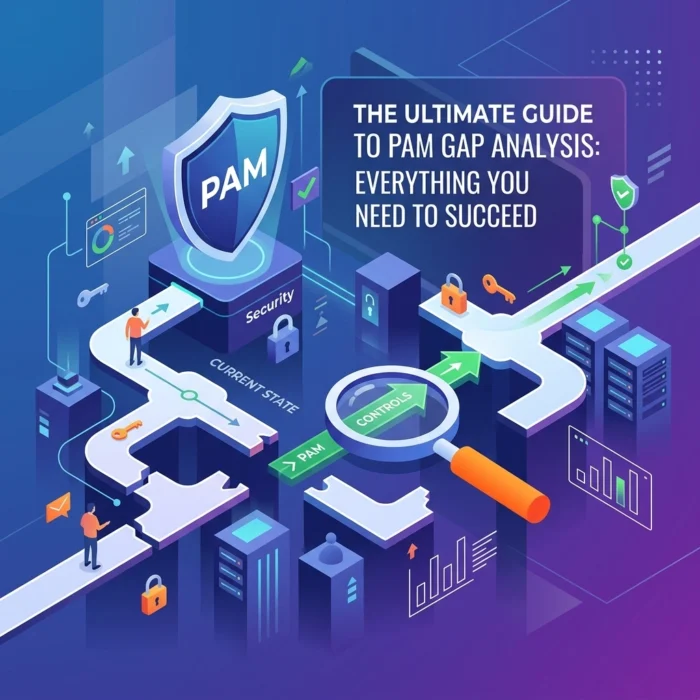
If you’ve ever felt like your security strategy is more "reactive" than "proactive," you’re not alone. In the world of cybersecurity, we often spend our time putting out fires rather than preventing them. But when it comes to your most sensitive credentials, "winging it" isn't an option. That’s where a PAM gap analysis comes in.
We know that privileged accounts are the "keys to the kingdom." If an attacker gets hold of an admin password or a service account credential, it’s game over. A PAM gap analysis is the process of looking at your current Privileged Access Management (PAM) state, comparing it to where it should be, and identifying exactly what’s missing.
In this guide, we’re going to break down everything you need to know to perform a successful analysis, close your security holes, and keep the auditors happy.
What Exactly is a PAM Gap Analysis?
At its simplest, a PAM gap analysis is a diagnostic tool. We use it to evaluate the distance between your current security posture and your desired security goals. Whether those goals are driven by internal safety standards or external regulations like NIST, ISO 27001, or SOC2, the analysis tells us exactly where the "gaps" are.
While people often confuse this with a broader IAM gap analysis (Identity and Access Management), the PAM version is laser-focused. While IAM looks at every user in the building, PAM focuses specifically on the users, processes, and systems that have "elevated" permissions: the people who can delete databases, change network configurations, or access sensitive HR files.
Why Do We Need One?
We perform these analyses for three main reasons:
- Risk Reduction: You can’t fix a hole you don’t know exists.
- Compliance: Most modern regulations require strict control over privileged access.
- Efficiency: It helps us stop spending money on tools we don’t need and start investing in the ones that actually solve our problems.
The Core Components of the Analysis
To do this right, we need to look at more than just software. A gap analysis that only looks at your tools is only half-finished. We categorize the analysis into three main buckets:
1. Visibility (The "Who" and "What")
You can't manage what you can't see. The biggest gap in most organizations is "shadow access": privileged accounts that were created for a project three years ago and never deleted. We need to identify every admin account, service account, and root user across your entire infrastructure.
2. Governance (The "Rules")
Who is allowed to request access? Who approves it? Is there a record of when they used it? If your policy says "Managers must approve access" but in reality, everyone just shares a password, that’s a massive gap.
3. Technology (The "How")
This is where we look at your actual PAM tools. Do you have a vault? Is it rotating passwords? Do you have session recording enabled? We analyze whether your current tech stack is actually capable of enforcing your policies.

Step-by-Step: How to Conduct Your PAM Gap Analysis
Conducting a gap analysis doesn't have to be a bureaucratic nightmare. We recommend a structured, clinical approach to ensure nothing gets missed.
Step 1: Define the Scope
Before we start poking around, we need to decide what we’re looking at. Are we analyzing the entire enterprise, or just our cloud environment? Defining the scope early prevents "scope creep" and keeps the project manageable.
2. Inventory Your Assets
We need to find every privileged account. This includes:
- Human Identities: Domain admins, database admins, and super-users.
- Non-Human Identities: Service accounts, API keys, and automated scripts.
- Third-Party Access: Vendors or contractors who have remote access to your systems.
You can find more technical details on how to categorize these assets in our official documentation.
3. Review Current Policies vs. Reality
This is the "Discovery" phase. We sit down and look at the written rules. Then, we look at what’s actually happening.
- Policy: All passwords must be 16 characters and rotated every 30 days.
- Reality: The "Admin" account has had the password "P@ssword123" since 2019.
That is a gap.
4. Identify the "Delta"
Now we compare our current state to our target state (usually a framework like NIST 800-53). Every time we find a requirement that isn't met, we document it as a gap.

Common Gaps: What We Usually Find
After running hundreds of these, we’ve noticed that most companies struggle with the same few issues. If you’re starting your analysis, keep an eye out for these "red flags":
- Unmanaged Service Accounts: These are the "silent killers." Because they aren't tied to a specific person, they often get ignored. They rarely have password rotation and often have way more permission than they actually need.
- Lack of Just-in-Time (JIT) Access: Many organizations still give users "standing privileges." This means an admin has admin rights 24/7, even when they’re just checking their email. A mature PAM state uses JIT access, where permissions are granted only when needed and revoked immediately after.
- Poor Session Monitoring: Knowing who logged in is one thing. Knowing what they did is another. A common gap is the inability to playback a privileged session to see exactly what commands were run.
- Shared Accounts: Using a single "root" or "admin" account for five different people. This makes accountability impossible.

Choosing a Framework for Your Analysis
We don't have to reinvent the wheel. Several industry-standard frameworks can guide your PAM gap analysis. Using these makes your final report much more authoritative when presenting to the board or auditors.
NIST SP 800-53
This is the gold standard for many, especially if you work with government entities. It provides a very granular list of controls for access management.
ISO/IEC 27001
If you’re looking for a more global standard, ISO focus on the "Management System." It’s less about the specific technology and more about the processes you have in place to manage risk.
The CIS Controls
For those who want something a bit more practical and less academic, the CIS Controls (specifically Control 4: Controlled Use of Administrative Privileges) offer a great starting point for closing gaps quickly.
Prioritizing Your Findings
Once you have your list of gaps, you’ll likely feel overwhelmed. You might have 50 different things that need fixing. We shouldn't try to fix them all at once. We prioritize based on Risk vs. Effort.
- Critical Risks (Low Effort/High Impact): Fix these today. Example: Disabling shared accounts or enforcing MFA on all admin logins.
- Strategic Gaps (High Effort/High Impact): These are long-term projects. Example: Implementing a full Just-in-Time access workflow.
- Compliance Gaps: Things that might not be high risk but are required by law to avoid fines.
How OrbisID Helps You Close the Gap
Identifying the gap is only half the battle. Closing it is where the real work happens. At OrbisID, we’ve designed our platform to address the most common gaps identified in these analyses.
- Automated Discovery: We help you find those "hidden" service accounts and unmanaged identities that usually slip through the cracks.
- Frictionless JIT Access: We enable your team to get the access they need without the traditional headaches, reducing the temptation to bypass security controls.
- Real-time Risk Dashboards: Our platform gives you a continuous view of your PAM posture, so your next gap analysis is essentially done in real-time.
If you’re ready to see where your organization stands, you can download our tools to start your discovery process or visit our homepage to learn more about our approach to modern PAM.

Final Thoughts: The Analysis Never Truly Ends
A PAM gap analysis isn't a "one-and-done" project. Our environments change every day: we add new cloud buckets, hire new contractors, and deploy new microservices. Each of these changes can create a new gap.
We recommend performing a deep-dive analysis at least once a year, with smaller "check-ups" every quarter. By staying on top of your privileged access, you aren't just checking a box for compliance: you’re making your organization a significantly harder target for attackers.
Don't wait for an audit to tell you what's wrong. Take the initiative, run the analysis, and secure your kingdom. If you need a partner to help navigate the technical complexities, we’re here to help. Explore our technical docs for deep dives into specific control implementations, and let's get those gaps closed.