
You’ve probably spent a significant portion of your budget on a high-end Privileged Access Management (PAM) solution. You’ve got the vault, the session recording, and the rotation policies in place. You feel secure. But here is the cold, hard truth: a PAM tool is only as effective as the accounts it actually knows about.
In the cybersecurity world, we often focus on the "management" part of PAM while completely neglecting the "discovery" part. If a rogue admin account exists outside your vault, it doesn't matter how strong your vault encryption is. That account is a wide-open door for attackers.
At OrbisID, we see organizations making the same mistakes over and over when it comes to privileged access discovery. These errors lead to "Shadow Privilege": a state where elevated access exists across your network, invisible to your security team and your IAM governance framework.
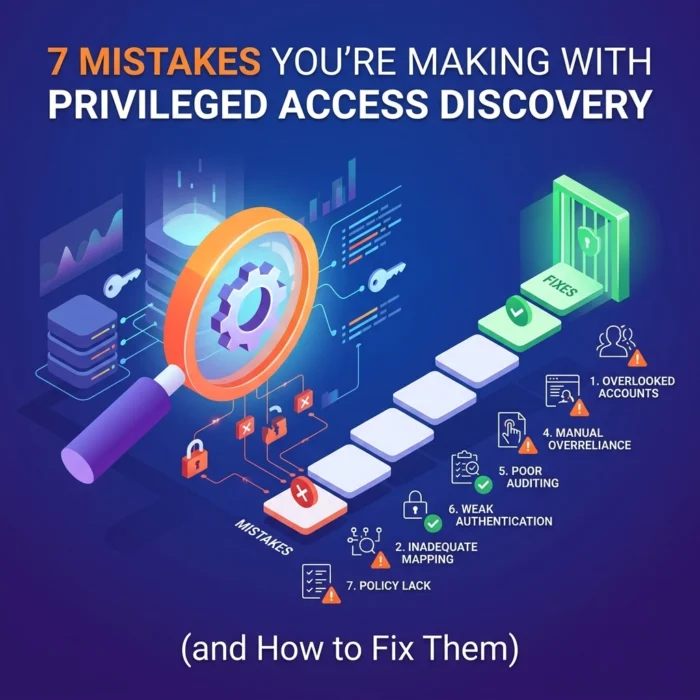
Here are the seven most common mistakes we see, and more importantly, how you can fix them.
1. Relying Solely on the "Managed Scope" of Your PAM Tool
The biggest misconception in the industry is that if an account isn't in your PAM tool, it isn't a risk. Most traditional PAM solutions are reactive; they manage what you tell them to manage. They don't proactively hunt for what’s missing.
When you rely only on the "managed scope," you are effectively wearing blinders. You see the 500 accounts you’ve onboarded, but you’re missing the 50 local admin accounts created by a DevOps engineer last Tuesday to troubleshoot a server issue.
The Fix: You need to decouple discovery from management. Use a dedicated discovery process that scans your entire environment: Active Directory, Entra ID (Azure AD), Linux servers, and Windows workstations: to find every account with elevated rights, regardless of whether it’s in your vault or not.
2. Overlooking Non-Human and Service Accounts
Humans are predictable. We use usernames and passwords, and we eventually leave the company. Service accounts, API keys, and automated task runners are a different beast entirely. They are often over-privileged, their passwords almost never change, and they are rarely documented.
We’ve found that in many enterprise environments, non-human accounts outnumber human privileged accounts by a ratio of 5 to 1. If your discovery process isn't specifically looking for service accounts and their associated permissions, you have a massive blind spot in your IAM governance.
The Fix: Ensure your discovery scans are "identity-aware." They should be able to identify accounts used by services and applications. Once discovered, these need to be mapped to an owner and integrated into your rotation schedule.

3. Treating Discovery as a One-Time Event
Many companies perform a "big sweep" during their initial PAM deployment. They find their accounts, shove them into the vault, and call it a day. The problem? Your IT environment changes every single hour.
New virtual machines are spun up, developers test new scripts, and contractors are granted temporary access. A discovery scan performed six months ago is essentially useless today. If you aren't discovering continuously, you are always one step behind the attackers.
The Fix: Automate your privileged access discovery. It should be a recurring, scheduled task that runs at least weekly, if not daily. This allows you to catch "ephemeral" accounts that are created and left behind before they can be exploited.
4. Ignoring Local Admins on Endpoints
It’s easy to focus on the data center and the cloud, but the humble workstation is often where the most dangerous shadow privileges hide. Local administrator accounts on laptops and desktops are the primary fuel for lateral movement during a ransomware attack.
If an attacker compromises a standard user account that happens to have local admin rights, they can disable security software, scrape memory for credentials, and move across your network. Many discovery tools skip endpoints because they are "too noisy" or "too numerous," but that's exactly where the risk lives.
The Fix: Extend your discovery reach to every endpoint. You need to know exactly who has administrative rights on every laptop in the fleet. This data is critical for achieving a true "Least Privilege" model.
5. Failing to Perform a PAM Gap Analysis
You have a list of accounts in your vault. You have a list of accounts found during discovery. Are you comparing them?
Mistake number five is failing to perform a PAM Gap Analysis. This is the process of reconciling your "Managed" list against your "Discovered" list. Without this reconciliation, you can't prove compliance with frameworks like NIST, ISO 27001, or SOC2. You might think you have 100% coverage when you actually have 60%.
The Fix: Implement a dashboard that visually represents the "gap." You should be able to see, in real-time, which discovered privileged accounts are not currently managed by your PAM tool. This makes remediation efforts targeted and efficient.

6. Not Identifying the "Identity Owner"
Discovery finds the what, but it often fails to find the who. Finding an account named svc_backup_01 is only half the battle. If you don't know which department or individual is responsible for that account, you can't safely rotate the password or disable it without risking a production outage.
This lack of ownership is why "zombie accounts" persist for years. Everyone is too afraid to delete them because nobody knows what they do.
The Fix: Your discovery process should attempt to correlate accounts with organizational data. Use your documentation and HR databases to assign ownership. If an account has no owner and hasn't been used in 90 days, it’s a prime candidate for decommissioning.
7. Discovery Without a Remediation Plan
The final mistake is treating discovery as a purely "informational" exercise. We see security teams generate massive spreadsheets of thousands of unmanaged privileged accounts, only for those spreadsheets to sit in a folder and gather digital dust.
Discovery without remediation is just a list of ways you can be hacked. It doesn't actually lower your risk profile until you take action.
The Fix: Build a workflow. When a new unmanaged privileged account is discovered, it should automatically trigger a ticket or an alert in your IAM system. Whether the fix is to onboard it into the vault, strip its privileges, or delete it, there must be a closed-loop process to ensure the "gap" is filled.
Why Discovery is the Absolute First Step
At OrbisID, we believe you can't secure what you don't know exists. This is why we advocate for discovery as the foundation of any serious cybersecurity strategy.
By avoiding these seven mistakes, you transition from a "hope-based" security model to a "visibility-based" one. You move from wondering if you’re covered to knowing exactly where your risks lie.
Effective privileged access discovery isn't just about finding accounts; it's about gaining the intelligence needed to make better decisions. It’s about ensuring that your IAM governance is based on reality, not just on the accounts that were convenient to onboard.

Take Control of Your Shadow Privileges
Are you ready to see what’s actually happening in your environment? Don't wait for an audit: or worse, a breach: to find out where your unmanaged accounts are hiding.
We’ve designed our platform to help you bridge the gap between discovery and management. If you’re ready to clean up your privileged access landscape, we’re here to help.
- See it for yourself: Download our latest tools to start your discovery journey.
- Learn the technicals: Check out our documentation to see how we handle complex enterprise environments.
- Get Started: Visit OrbisID.com to learn more about our approach to PAM and identity security.
The era of "set it and forget it" security is over. It’s time to shine a light on your privileged access.