
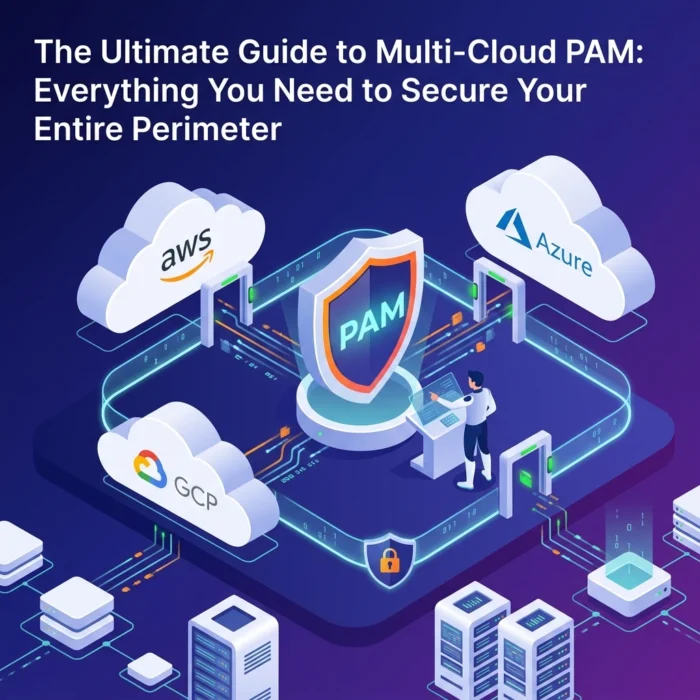
Let’s face it: the days of having a nice, neat server room in the basement are long gone. In 2026, your "perimeter" is likely a messy mix of AWS, Azure, Google Cloud, and maybe some legacy on-prem hardware that just won't quit. We live in a multi-cloud world, and while that gives us incredible scaling power, it also creates a massive security headache.
When your team is spinning up resources across three different cloud providers, how do you keep track of who has privilege access to what? Traditional, static security models can't keep up. That’s where multi-cloud Privileged Access Management (PAM) comes in. It’s the only way to ensure that "the keys to the kingdom" don't end up in the wrong hands.
In this guide, we’re going to break down exactly what you need to build a modern, multi-cloud PAM strategy that actually works without slowing your developers down.
The Reality of the Modern Perimeter
The traditional perimeter: that firewall "moat" around your office: is effectively dead. Today, identity is the new perimeter. Whether an admin is logging into a production database from a coffee shop or a service account is calling an API in a different region, the only thing standing between your data and a breach is how you manage that specific identity.
Multi-cloud environments introduce "Identity Sprawl." Each provider has its own way of handling roles and permissions. If you’re trying to manage these separately, you’re going to have gaps. We call these "blind spots," and they are exactly what attackers look for.

Why Legacy PAM Fails in the Cloud
Most legacy enterprise PAM solutions were built for a world where servers had names and IP addresses that stayed the same for five years. In the cloud, infrastructure is ephemeral. It’s here one minute and gone the next.
If your PAM tool requires manual onboarding for every new instance, your security is already behind. You need a solution that integrates directly into the cloud fabric, discovering and securing accounts automatically as they are created.
The 7 Pillars of Multi-Cloud PAM
To secure a hybrid or multi-cloud environment, we believe you need to focus on these seven core pillars.
1. Continuous Discovery and Inventory
You can’t protect what you don’t know exists. A multi-cloud environment is dynamic. We need tools that constantly scan your AWS, Azure, and GCP environments to find new privileged accounts, service identities, and "shadow" instances that might have been spun up for a quick project and then forgotten.
2. Centralized Credential Management
Stop letting your team store SSH keys on their desktops. We need to centralize all secrets and credentials in a secure vault. By managing these in one place, we can enforce automatic rotation and eliminate the risk of hard-coded passwords in your DevOps scripts.
3. Just-in-Time (JIT) Access
This is the gold standard of modern security. Why should an admin have "always-on" access to your production database? With JIT, we grant privilege access only when it’s needed, for a specific window of time, and for a specific task. Once the job is done, the access expires. No standing privileges means no sitting targets for hackers.
4. Session Monitoring and Recording
If something goes wrong, we need to know exactly what happened. Recording privileged sessions: whether they are via RDP, SSH, or a web console: provides an audit trail that is essential for both compliance and forensic analysis. It’s not about "spying" on your team; it’s about having a clear record of truth.
5. Securing the DevOps Pipeline
Your CI/CD pipeline is one of the most privileged "users" in your company. It has the power to deploy code and change infrastructure. We must treat these machine identities with the same level of scrutiny as human admins. This means securing secrets used by Jenkins, GitLab, or GitHub Actions.
6. Unified Visibility
You shouldn't have to jump between three different cloud consoles to see who has admin rights. A proper multi-cloud PAM solution provides a "single pane of glass." We need to see the risk posture of our entire estate from one dashboard.
7. Automation and Orchestration
In a hybrid environment, manual processes are the enemy of security. We need to automate the onboarding of accounts and the response to suspicious activity. If a user suddenly requests access to ten sensitive systems at 3:00 AM, our systems should be able to flag or block that automatically.
The "Shadow Privilege" Problem
One of the biggest risks in multi-cloud security is what we call "Shadow Privilege." These are accounts that have admin-level permissions but aren't being tracked by your security team. This happens often when developers create temporary "test" accounts with full permissions to avoid friction during a build.

Using a reconciliation dashboard, like the one we provide at OrbisID, allows us to compare what's actually in your cloud environment versus what's managed in your PAM tool. If there’s a discrepancy, that’s a gap that needs to be closed immediately.
Best Practices for Hybrid Environments
If you’re managing both on-prem data centers and cloud instances, you’re in a "hybrid" world. This is arguably the most difficult environment to secure. Here are a few tips to keep things tight:
- Bridge the Identity Gap: Use a central identity provider (like Okta or Azure AD) and sync it with your PAM solution. This ensures that when someone leaves the company, their access is revoked across everything instantly.
- Enforce MFA Everywhere: Multi-factor authentication is no longer optional. Every privileged login must require a second factor: no exceptions.
- Segment Your Networks: Don't let a breach in a dev environment move laterally into your production environment. Use micro-segmentation to keep your most sensitive assets isolated.
- Review Your Docs Regularly: Security standards change fast. Make sure your team is up to speed on the latest implementation guides. You can find our technical resources at https://orbisid.com/docs.
Compliance Isn't Just a Box to Check
Whether it’s NIST, ISO 27001, or SOC2, most regulatory frameworks now require strict control over privileged access. For those in highly regulated industries like finance or healthcare, the stakes are even higher.
A multi-cloud PAM strategy doesn't just make you more secure; it makes your audits significantly less painful. When the auditors show up, you can pull a single report that shows exactly who had access to what and why.

By mapping your PAM coverage to specific frameworks, you can identify exactly where you are falling short before the auditors do. We recommend running a gap analysis monthly to stay ahead of the curve.
Getting Started with OrbisID
Building a multi-cloud PAM strategy sounds like a massive undertaking, but it doesn't have to happen all at once. Start by identifying your most critical systems: your "crown jewels": and secure those first.
At OrbisID, we’ve designed our enterprise PAM solutions to be easy to deploy and even easier to use. We focus on removing the friction from security so your team can focus on building great products.
If you’re ready to see how your current environment stacks up, we’re here to help. You can start by checking out our site at https://orbisid.com to learn more about our approach to hybrid security.
Ready to take the next step? You can download our latest security tools here to begin securing your perimeter today.
Final Thoughts
The cloud has changed the game, but the goal remains the same: keep the bad guys out and keep your data safe. In a multi-cloud world, you can't rely on luck or manual processes. You need a strategy that is as dynamic and scalable as the clouds you're operating in.
By focusing on centralized visibility, Just-in-Time access, and automated discovery, we can turn a complex security nightmare into a streamlined, secure operation. It’s time to stop chasing shadows and start taking control of your privilege access.