
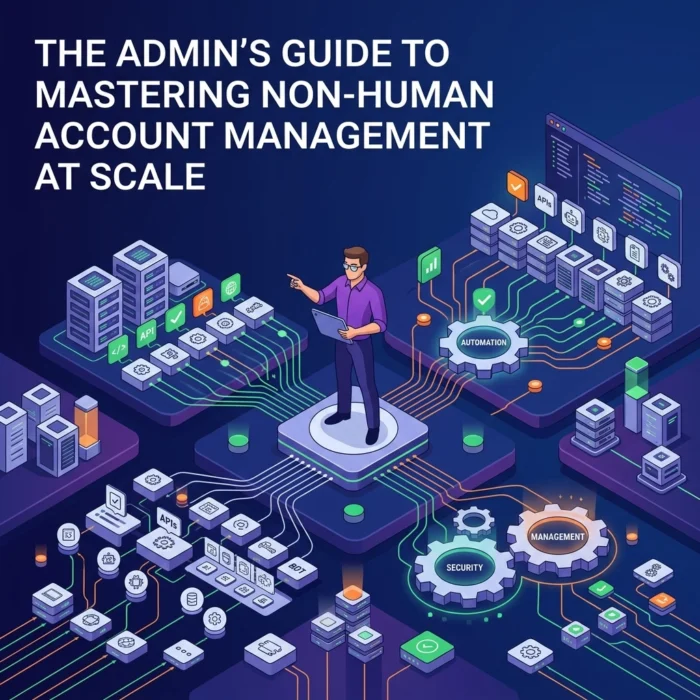
Let’s be honest: in the modern enterprise, the "humans" are officially outnumbered. For every employee logging into your network, there are likely five, ten, or even fifty non-human identities (NHIs) humming away in the background. We are talking about service accounts, API keys, secrets, tokens, and bots that keep your CI/CD pipelines flowing and your cloud infrastructure standing.
The problem? Most organizations treat these non-human accounts like the "dark matter" of cybersecurity. We know they are there, we know they are heavy, but we can’t always see them: and we certainly don’t manage them with the same rigor as we do human users. Managing non-human account management at scale isn't just a technical challenge; it’s a governance necessity. If you don't control them, they become the primary path for lateral movement during a breach.
In this guide, we will walk through how to move from "accidental" service account creation to a structured, scalable management framework.
The Invisible Risk: Why Non-Human Identities Are Different
Unlike your human coworkers, non-human accounts don’t forget their passwords, but they also don’t retire, complain about over-privileged access, or leave the company when their project ends. They are static, often over-privileged, and frequently hard-coded into scripts that nobody wants to touch for fear of "breaking the build."
From a clinical perspective, NHIs present three primary risks:
- Lack of Ownership: Who "owns" the service account created by a developer who left three years ago?
- Static Credentials: Many NHIs use long-lived secrets that are rarely, if ever, rotated.
- Shadow Privileges: Because these accounts are often created "on the fly" to solve immediate integration issues, they often end up with broad administrative rights that exceed their functional requirements.
To solve this, we must first find them.
Step 1: Automated Discovery and Inventory
You cannot secure what you cannot see. The first step in mastering non-human account management is creating a certifiable inventory. Relying on manual spreadsheets or "word of mouth" among the engineering team is a recipe for disaster. We recommend an automated approach to discovery that scans your cloud environments (AWS, Azure, GCP), on-premise Active Directory, and SaaS platforms.

When we perform discovery, we are looking for the "Chain of Trust." This means mapping the consumer (the workload or bot) to the credential, then to the identity, and finally to the resource it accesses. If any link in this chain is missing, you have an unmanaged risk.
Technical Specifications for Discovery:
- Infrastructure Scanning: Regularly audit IAM roles and service principals.
- Log Analysis: Review authentication logs to identify "zombie" accounts that haven't been used in 90+ days.
- Secret Detection: Use tools to find hard-coded secrets in code repositories and configuration files.
Step 2: Privileged Account Classification
Once you have a list of all non-human accounts, the next step is privileged account classification. Not all service accounts are created equal. A bot that posts to a Slack channel does not require the same level of scrutiny as a service principal with "Contributor" access to your production Kubernetes cluster.
We categorize NHIs into three distinct risk tiers:
Tier 1: High-Privilege / Infrastructure
These are accounts with administrative access to core infrastructure, security tools, or financial databases. If compromised, these lead to total system takeover. These accounts require immediate integration into a Privileged Access Management (PAM) solution.
Tier 2: Operational / Middleware
These accounts facilitate data movement between applications. They might have read/write access to specific databases but cannot modify the underlying infrastructure.
Tier 3: Low-Impact / Ephemeral
These are short-lived tokens or accounts used for specific, low-risk tasks. While they still require management, they are lower priority for deep governance reviews.
By applying strict privileged account classification, we allow security teams to focus their limited resources on the accounts that actually matter. You can learn more about how we handle these classifications at orbisid.com.
Step 3: Establishing Ownership and Governance
The "Who owns this?" question is the hardest part of NHI management. In many cases, the creator of the account is a pipeline, not a person. To scale, we must move away from individual "gatekeepers" and toward a model of federated ownership.
We advocate for a governance model where:
- Security defines the boundaries: We set the policies on what permissions are allowed.
- DevOps/Engineering owns the identity: The teams creating the workloads are responsible for documenting the purpose and lifecycle of the associated NHIs.
Every non-human account must be tied to a functional owner or a specific application ID. When an application is decommissioned, its non-human identities must be automatically flagged for deletion.

Step 4: Implementing Lifecycle Management
Lifecycle management for humans is easy: they get hired, they change jobs, they leave. For non-human accounts, the lifecycle is often ignored. A robust non-human account management strategy requires a "cradle-to-grave" approach:
- Provisioning: Accounts should be created via Infrastructure as Code (IaC) with pre-defined, least-privilege roles.
- Authentication: Whenever possible, move away from long-lived passwords and toward certificate-based authentication or short-lived OIDC tokens.
- Rotation: Credentials must be rotated automatically. If a service account's password hasn't changed in a year, it’s a ticking time bomb.
- Decommissioning: This is the most skipped step. We must implement automated cleanup workflows that trigger when a project or workload is retired.

Step 5: Enforcing Least Privilege at Scale
"Least Privilege" is a term thrown around a lot, but for non-human accounts, it means being clinically precise. If a bot only needs to upload files to a specific S3 bucket, it should not have permissions to "List All Buckets."
To enforce this at scale:
- Remove Default Admin Access: No service account should ever start with "Domain Admin" or "Global Admin" rights.
- Use Condition-Based Access: Restrict NHI usage to specific IP ranges or VPCs.
- Audit Runtime Activity: Compare what the account can do with what it actually does. If an account has 100 permissions but only uses 3, trim the rest.
Step 6: Monitoring and Compliance Gap Analysis
In regulated industries, you have to prove that your non-human accounts are secure. This is where many organizations struggle during audits. You need to be able to show a clear map of who has access to what and why.

Using a centralized dashboard, we can perform a "PAM Gap Analysis." This identifies which high-risk non-human accounts are currently unmanaged or operating outside of company policy. This data is vital for meeting frameworks like NIST, ISO 27001, or SOC2. You can find detailed documentation on setting up these compliance checks at orbisid.com/docs.
Scaling the Future with OrbisID
Mastering non-human identity management isn't a one-time project; it’s an ongoing operational discipline. As your company grows and your cloud footprint expands, the number of bots and service accounts will only increase.
At OrbisID, we focus on revealing the "Shadow Privileges" that traditional PAM tools often miss. By integrating discovery, classification, and lifecycle management into a single workflow, we enable organizations to move fast without leaving the door open for attackers.
If you are ready to take control of your non-human workforce, you can start by identifying the gaps in your current strategy. We provide the tools to visualize your risk and automate the remediation process.
Next Steps for Admins:
- Download our discovery checklist: Visit orbisid.com/download to get started.
- Run a scan: Identify your top 10 most privileged service accounts.
- Assign Owners: Ensure every high-privilege account has a living, breathing person responsible for its existence.
The era of ignoring non-human accounts is over. By treating these digital entities with the same respect: and scrutiny: as human users, we can build a significantly more resilient enterprise. For more information on how to secure your privileged access, visit orbisid.com.